AI PLATFORM
Enterprise AI Control Plane
Unify model operations, GPU scheduling, usage governance, and enterprise AI workflows across distributed infrastructure.
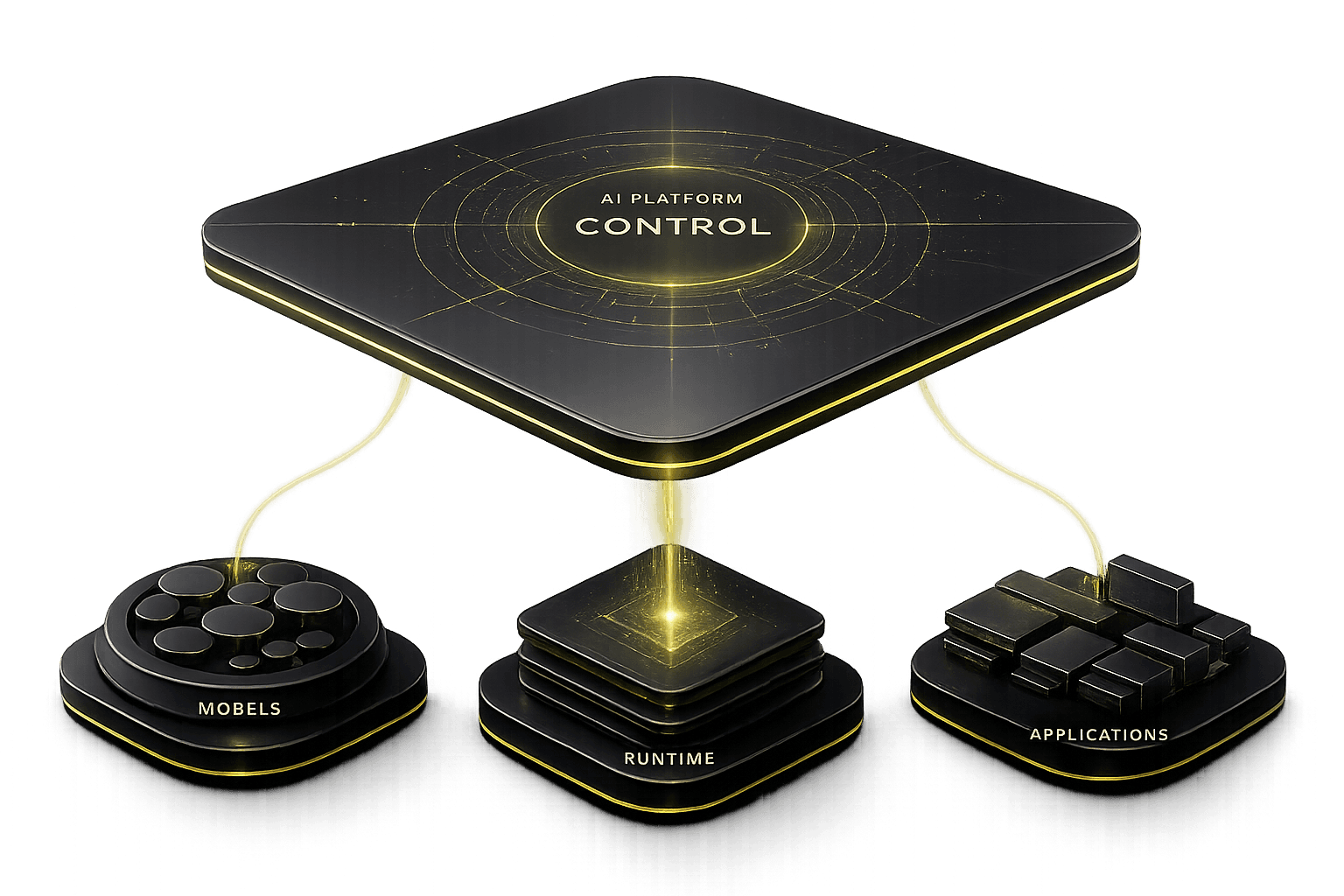
AI OPERATING LAYERS
AI Operating Layers
A platform layer that connects applications, models, AI runtime and infrastructure into one enterprise operating system.
PLATFORM CAPABILITIES
One Platform for Enterprise AI Operations
Operate models, workloads, infrastructure, governance, and usage visibility through a unified enterprise AI control plane.
01
Model Operations
Deploy, route, monitor, and manage enterprise models across APIs, private endpoints, and internal AI services.
02
GPU Workload Orchestration
Schedule inference, batch jobs, agents, and AI workloads across available GPU infrastructure.
03
Usage Governance
Track usage, quotas, approvals, policies, and chargeback across teams, projects, and customers.
04
Infrastructure Integration
Connect GPU Cloud, storage, networking, private AI clusters, and third-party infrastructure into one operating layer.
05
Observability & Reliability
Monitor latency, availability, workload health, capacity utilization, and runtime performance.
06
Enterprise Workflow Layer
Support AI applications, agents, internal tools, and business workflows through a governed platform interface.
ENTERPRISE AI CONTROL PLANE
One Control Plane Across the Enterprise AI Stack
The AI Platform connects applications, models, runtime, GPU infrastructure, and enterprise operations into one unified operating system.
Enterprise Applications
Layer 00
Application Layer
Layer 01
Model Layer
Layer 02
AI Runtime
Layer 03
Infrastructure Layer
Layer 04
Physical Infrastructure
Layer 05
AI RUNTIME ENGINE
The Intelligence Behind Every AI Workload
The AI Runtime Engine continuously schedules, routes, executes, and optimizes AI workloads across distributed enterprise infrastructure.
Runtime Core
AI Runtime Engine
Scheduling · Routing · Execution · Optimization
Place workloads across available infrastructure based on priority, capacity, and operating policy.
Route requests across models, endpoints, and runtime paths for resilient execution.
Execute production inference workloads through a governed enterprise runtime layer.
Coordinate agents, tools, workflows, and model calls across enterprise AI systems.
Continuously optimize placement, caching, batching, and GPU utilization.
Capture runtime signals for workload health, availability, latency, and utilization.
MODEL LIFECYCLE
Manage Every Model from Deployment to Optimization
Register, deploy, route, observe, optimize, and retire models through one governed enterprise AI platform.
STAGE 01
REGISTER
Model Catalog
Connect OpenAI, Anthropic, DeepSeek, Qwen, Llama, and private models into a unified model catalog.
STAGE 02
DEPLOY
Enterprise APIs
Publish models to governed APIs, private endpoints, internal tools, and enterprise AI workflows.
STAGE 03
ROUTE
Policy Engine
Select the right model and endpoint based on latency, cost, policy, workload type, and availability.
STAGE 04
OBSERVE
Runtime Metrics
Track latency, usage, errors, quality signals, availability, and operational health.
STAGE 05
OPTIMIZE
GPU Efficiency
Improve throughput, cache reuse, placement, batching, cost efficiency, and GPU utilization.
STAGE 06
RETIRE
Version Control
Deprecate models safely with version control, migration paths, approvals, and audit history.
INFRASTRUCTURE INTEGRATION
One Platform.
Every Infrastructure Domain.
The AI Platform unifies compute, storage, networking, platform services, and AI factory infrastructure into one intelligent operating layer.
Central Hub
AI Platform
Enterprise Control Plane
Domain 01
Compute
Domain 02
Storage & Networking
Domain 03
AI Platform Services
Domain 04
AI Infrastructure Foundation
01
GPU Cloud
02
AI Infrastructure
03
Facility Integration
04